Still on Dynamics AX 2012? Why the Move to Dynamics 365 Can’t Wait Any Longer
Dynamics AX 2012 has been out of support for years. Here’s what the delay is really costing, what companies that moved have gained, and how to plan the upgrade.
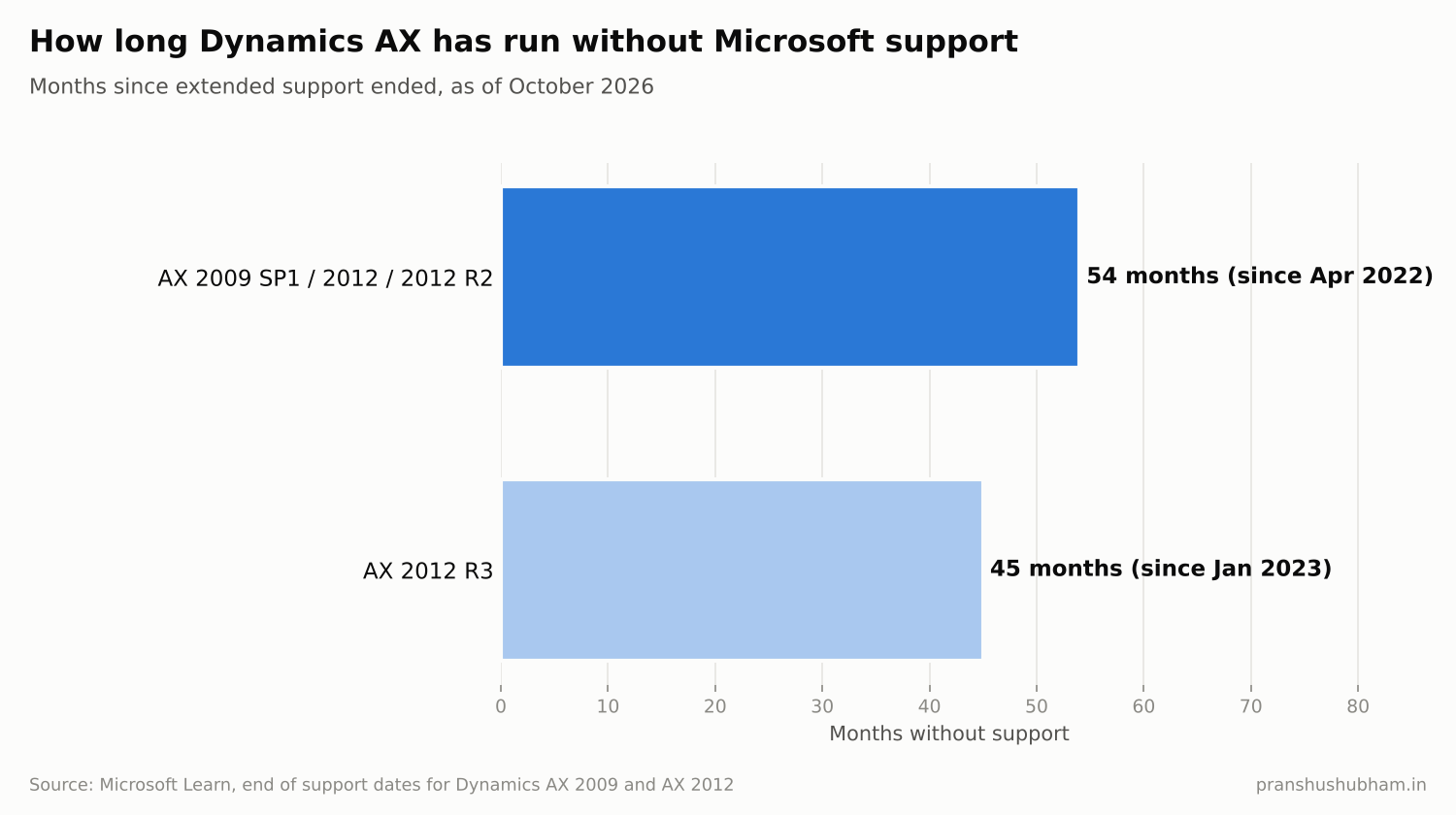
Months since AX end of support chart
Thousands of companies still run Dynamics AX 2012. It works, people know it, and the customizations fit like a glove. But the clock ran out a long time ago.
According to Microsoft Learn, mainstream support for Dynamics AX 2012 R3 ended on October 12, 2021, and extended support ended on January 10, 2023. For AX 2009 SP1, AX 2012 and AX 2012 R2, extended support ended on April 12, 2022. That means no security updates, no regulatory updates and no fixes, for more than three and a half years in the best case.
What waiting really costs
Staying on AX isn’t free, even if the license is paid for:
- Security risk: an unpatched ERP holds your financial, customer and supplier data.
- Infrastructure cost: on-premises servers, SQL licenses and the people to run them.
- Integration drag: modern tools, from e-commerce to AI agents, are built for cloud APIs.
- Talent risk: fewer consultants and developers want to work on AX each year.
- Lost capabilities: Copilot, AI agents, Planning Optimization and Fabric analytics are only available on Dynamics 365.
Case study: Sonee Sports
Sonee Sports, a sports and lifestyle retailer in the Maldives, moved from Dynamics AX to Dynamics 365. According to Microsoft’s Dynamics 365 blog, the company:
- Cut IT maintenance costs by 38%
- Improved customer retention by over 8%
Lower maintenance costs are the expected benefit of leaving on-premises AX. Better customer retention is the bonus that comes from modern retail and customer capabilities.
A larger example: TalkTalk
UK telecom provider TalkTalk also replaced an end-of-life AX 2012 with Dynamics 365 Finance. According to Microsoft’s customer story, it saved about £100,000 a year in support costs, avoided £140,000 in infrastructure upgrades, and expects total savings of half to three-quarters of a million pounds a year. (I cover TalkTalk in more detail in my post on cloud ERP ROI.)
Forrester’s older 2020 Total Economic Impact study of migrating from AX to Dynamics 365, commissioned by Microsoft, modeled a 109% ROI with a 6-month payback for its composite organization.
Upgrade or reimplement?
Microsoft provides a data upgrade path from AX 2012 to Dynamics 365 F&O. The choice usually comes down to how far your AX has drifted from standard:
- Upgrade (lift the data and code): faster, keeps history, but carries old customizations forward.
- Reimplement (fresh start): more work, but a chance to return to standard processes and drop customizations the business no longer needs.
- Hybrid: upgrade the data, but review every customization against standard D365 before rebuilding it.
Six steps to plan your move
- Inventory your customizations. List each one, who uses it and whether standard D365 now covers it.
- Assess data quality. Archive what you don’t need. Don’t migrate ten years of history unless you must.
- Map integrations. Every interface needs a new design for the cloud.
- Choose upgrade, reimplement or hybrid based on that inventory, not habit.
- Plan for people. Users who’ve known AX for 10+ years need real change management, not just training.
- Set a date. The biggest risk is another year of “next year.”
FAQ
Is Dynamics AX 2012 still supported? No. Extended support for AX 2012 R3 ended on January 10, 2023, and for AX 2009 SP1, AX 2012 and AX 2012 R2 on April 12, 2022, according to Microsoft Learn.
Can I upgrade AX 2012 data to Dynamics 365? Yes. Microsoft provides an upgrade path from AX 2012 to Dynamics 365 finance and operations apps. Many companies combine a data upgrade with a review of customizations.
The takeaway
AX 2012 served many businesses well, but it has been unsupported for years. The companies that moved are already seeing lower costs and new capabilities. The cost of waiting grows every month.
I’m Pranshu Shubham, a D365 F&O Solution Architect. If you’re planning a move from AX to Dynamics 365, get in touch.