Unified Commerce with Dynamics 365: How MEC Connected Stores, Online and Finance
Online is now 17.1% of US retail sales, and shoppers expect stores and websites to act as one. Here’s how MEC replaced an AS400 with Dynamics 365 to get there.
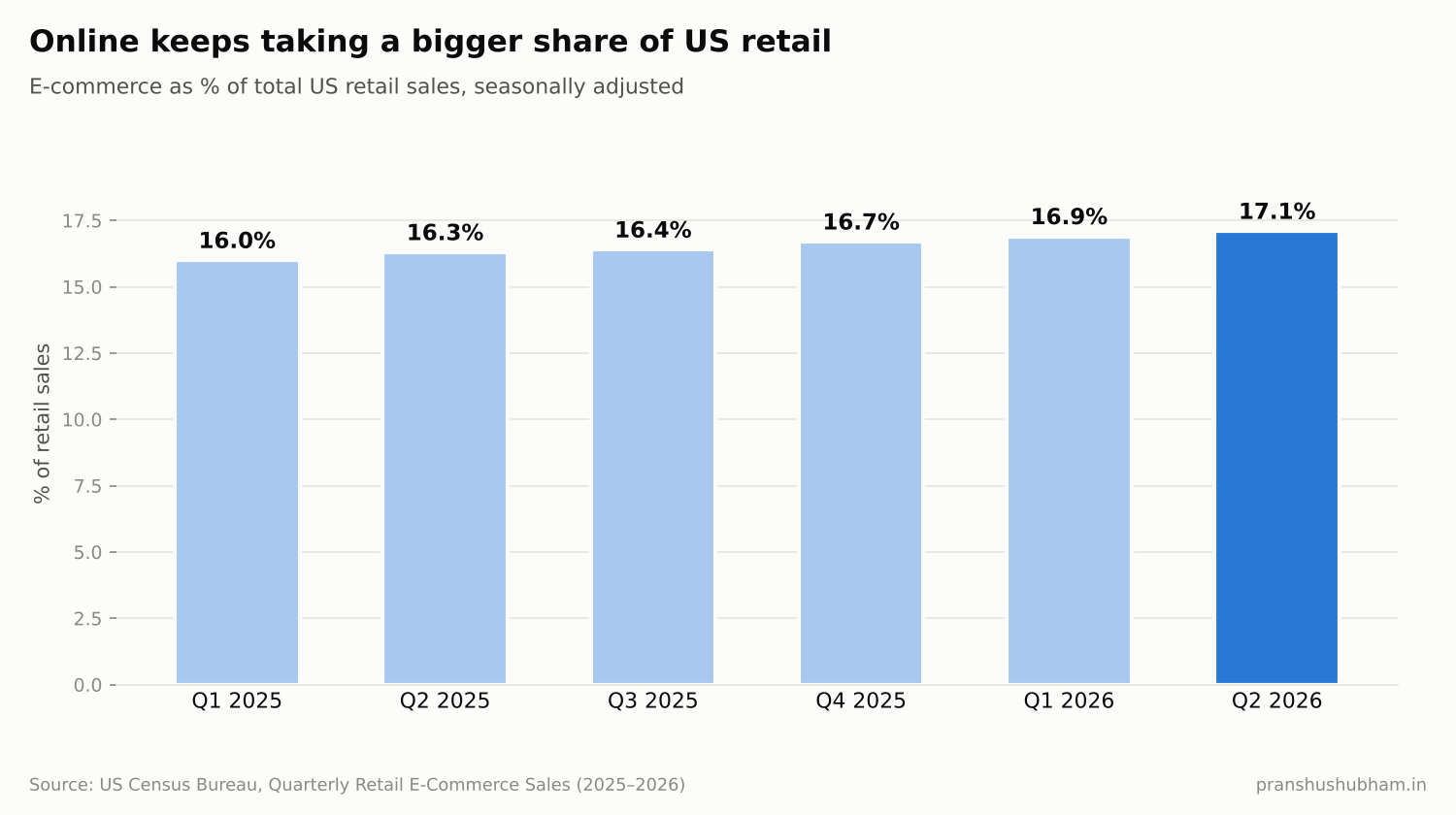
US e-commerce share of retail chart
Retail used to have two businesses under one brand: stores and a website, each with its own stock, prices and customers. Shoppers never saw it that way, and now the numbers make the case impossible to ignore.
According to the US Census Bureau, e-commerce reached $340.2 billion in Q2 2026, or 17.1% of total US retail sales, up 12.2% year over year. In Q1 2026, e-commerce grew 9.8% while total retail grew just 3.9%.
But online growth doesn’t mean stores matter less. Ryder’s 2025 e-commerce study found that 71% of online shoppers who picked up in store did so to avoid shipping costs, and 54% prefer to return items in store. The winning model is unified commerce: one platform for stock, orders, customers and prices across every channel.
Case study: MEC replaces an AS400 with Dynamics 365
Mountain Equipment Company (MEC), the Canadian outdoor retailer, ran its business on an AS400 legacy ERP. It lacked integration, speed and visibility, and that held back every omnichannel ambition.
MEC moved in stages. It implemented Dynamics 365 Finance in 2019, then added Supply Chain Management and Commerce in 2023, along with Power Apps, Power Automate, Azure and an integration with its BigCommerce website. Product availability on the website now updates every 15 minutes.
According to Microsoft’s published customer story:
- Month-end close is at least 20% faster
- Transaction times are down by nearly 50%
- The POS transition took weeks instead of a nearly two-year project
- About 20% of customers now use buy online, pick up in store (BOPIS)
- Loyalty members spend 25% more
What unified commerce means in Dynamics 365
Dynamics 365 Commerce combines headquarters, store and online capabilities on the same data as Supply Chain Management and Finance:
- One product and price master for every channel
- Store Commerce point of sale, working online or offline
- Order orchestration across channels: buy online, pick up in store; ship from store; endless aisle
- Customer and loyalty data shared between stores and online
- Inventory visibility across stores and distribution centers
- Financial posting of store transactions through statements
Five lessons from MEC
1. Migrate in waves. MEC started with Finance, then added supply chain and commerce. Each wave reduced risk for the next.
2. Make stock availability a first-class design topic. BOPIS fails when the website promises stock the store doesn’t have. Decide how often availability refreshes, and plan safety stock for online orders.
3. Keep one customer record. Loyalty members spending 25% more only works if stores and online see the same customer.
4. Design for returns anywhere. Cross-channel returns are where most omnichannel designs break. Test them early.
5. Measure the store’s role in digital sales. Track the share of online orders fulfilled or picked up in store. MEC’s 20% BOPIS share shows how much the store contributes.
FAQ
What is unified commerce? Unified commerce means running stores, e-commerce and back office on one platform with shared stock, prices, orders and customers, rather than connecting separate systems.
Does Dynamics 365 Commerce support BOPIS? Yes. Dynamics 365 Commerce supports buy online, pick up in store, alongside ship-from-store and other cross-channel order scenarios.
The takeaway
The line between online and in-store is gone for shoppers. MEC’s results show what happens when it’s gone in the systems too: faster transactions, faster close and customers who spend more.
I’m Pranshu Shubham, a D365 F&O Solution Architect who has led retail programs with POS, EDI and WMS integrations. If you’re planning unified commerce on Dynamics 365, get in touch.